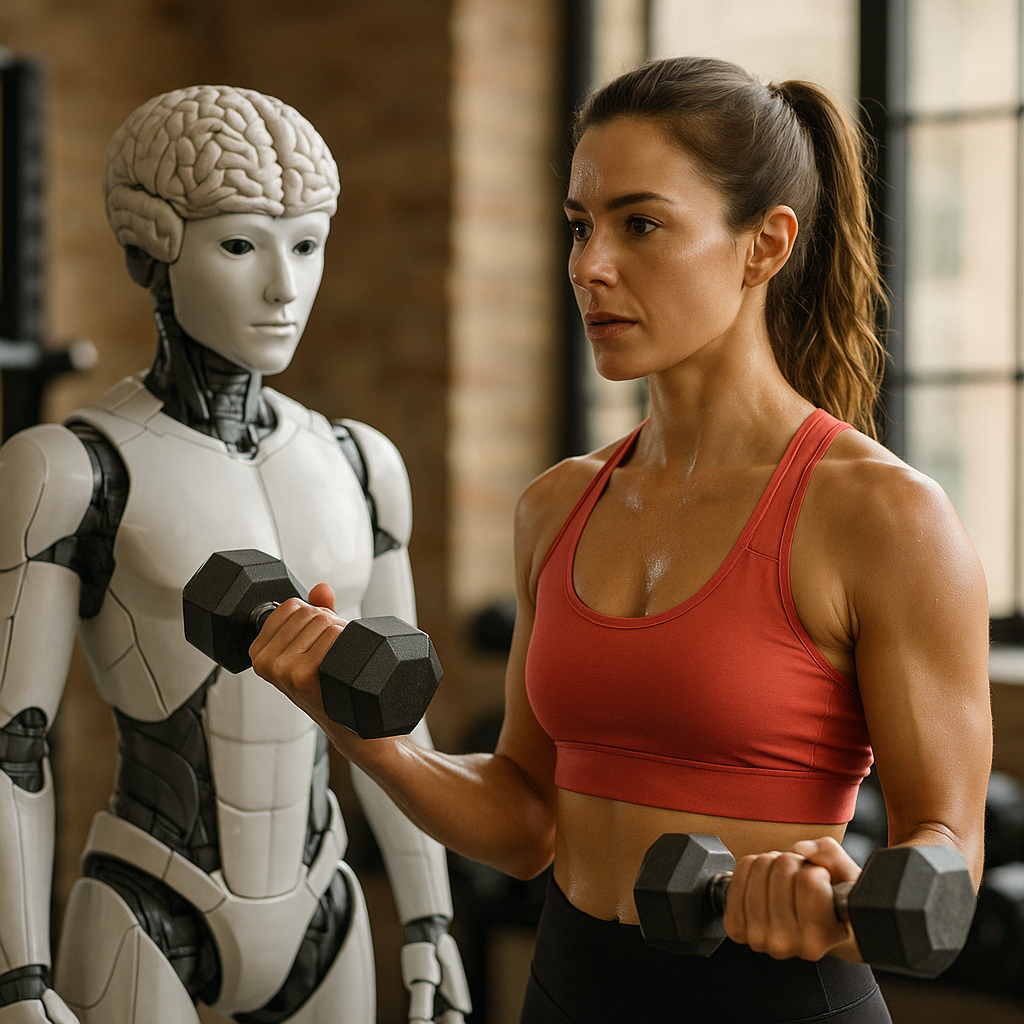
Why AI May Not Need Endless Data: Lessons from Brain-Inspired Design
Recent research suggests an alternative to the “scale-only” strategy in AI: instead of always adding more data, compute, and parameters, we can redesign architectures to incorporate structural priors inspired by biological brains. Early experiments show some architectures produce brain-like dynamics with little or no training, and those innate dynamics can make subsequent learning faster and cheaper. That doesn’t replace scale in every case, but it opens a complementary path for sample-efficient, lower-cost, and on-device AI.
Quick summary
- Brain-inspired architectural choices (sparsity, local wiring, recurrent loops, modulatory units) act as inductive biases that reduce the data needed to learn.
- Some modified networks show emergent, brain-like activity before gradient training, suggesting architecture can create useful dynamics rather than relying solely on data to form them.
- Practical benefits include faster prototyping, lower training costs, and smaller energy footprints—especially important for edge and resource-limited deployments.
- These approaches are complementary to large models; rigorous benchmarking, careful validation, and ethical oversight are still essential.
Why this matters
The prevailing trend—bigger models trained on ever-larger datasets—has driven progress but also raised costs, carbon footprints, and entry barriers for small teams. Architectures that bake in useful structure can shift some of the burden off data and compute, enabling useful AI in contexts where labeled data or power is scarce.
What researchers are finding
Across multiple labs, researchers have shown that introducing biologically inspired constraints can cause networks to produce organized activity patterns without extensive training. In some cases, activity patterns resemble those seen in animal neural recordings; in others, the structure simply accelerates learning when training is applied. These results are intriguing because they suggest we can move from a blank-slate learning model toward designs that arrive at better inductive starting points.
How brain-inspired design reduces data needs
Inductive biases: the architecture as a head start
Biological systems aren’t blank slates; their wiring and cell types encode priors that guide learning. Translating a few of these principles—local connectivity, sparse activations, recurrence, and modulatory gating—can bias AI models toward useful representations and reduce the number of labeled examples needed to reach competence.
Emergent functional dynamics
When an architecture already supports certain dynamical regimes, training can refine those dynamics instead of building them from scratch. That often translates into faster convergence, better sample efficiency, and more robust behaviors after fewer updates.
Efficiency and deployment benefits
Smaller models with appropriate structure can be cheaper to train and run, making AI practical for on-device applications (e.g., mobile health, personal assistants) and for organizations with limited compute budgets. Real efficiency gains depend on implementation and hardware choices, so measure energy and latency in your target deployment.
Practical roadmap for teams
Moving from concept to working systems requires a mix of experiments, metrics, and cross-disciplinary input. Below is a pragmatic sequence to try.
Step-by-step
- Pick target problems where labeled data or inference cost is a bottleneck (small datasets, privacy-constrained data, edge devices).
- Identify a small set of architectural priors to test (e.g., local receptive fields, sparse activations, recurrent loops, gating mechanisms).
- Prototype minimal changes to an existing model rather than redesigning everything—compare baseline vs. structured variant.
- Prefer self-supervised or unsupervised objectives where possible to refine innate dynamics before heavy supervised training.
- Run ablation studies to quantify which structural elements matter and why.
Checklist for deployment experiments
- Define success metrics beyond accuracy: sample efficiency, training compute, inference latency, energy consumption, robustness.
- Document training regimes, hyperparameters, and initialization details for reproducibility.
- Collaborate with domain experts (neuroscientists, cognitive scientists) when translating biological ideas.
- Plan safety and misuse mitigation early—sample-efficient systems can still be misapplied.
Benchmarks and validation
To judge whether a brain-inspired design is truly better, evaluate along multiple axes:
- Sample efficiency: amount of labeled data required to reach target performance.
- Compute and energy: wall-clock training time, FLOPs, and measured power consumption on target hardware.
- Robustness: behavior under distribution shift, noise, and adversarial inputs.
- Functional relevance: do emergent dynamics correspond to improved task performance or just superficial similarity to neural signals?
Common pitfalls
- Assuming structure alone is a silver bullet: architecture helps, but optimization, data quality, and training procedures still matter.
- Overgeneralizing preliminary findings: brain-like activity in simplified networks does not imply human-like cognition or safety.
- Copying biological detail indiscriminately: not every neurobiological mechanism is practical or beneficial in silicon.
- Neglecting benchmark diversity: avoid evaluating on only toy tasks—use realistic, varied datasets for assessment.
- Ignoring deployment constraints: a structured model that remains too large or power-hungry won’t solve edge problems.
Limitations and ethical considerations
There are important limits and responsibilities to keep in mind. Emergent brain-like dynamics are not equivalent to understanding, reasoning, or consciousness. Highly sample-efficient models could be misused if released without guardrails. And translating biology into engineering requires humility: evolution produced solutions under specific constraints that do not always map directly to computing systems. Interpretability, robustness, and governance must advance in parallel.
Conclusion
Brain-inspired design offers a promising complement to scale: by embedding useful priors into architecture, researchers and engineers can often reduce dependence on massive datasets and costly compute. These approaches are not a universal replacement for large models, but they expand the toolbox—especially for resource-constrained applications. Success will depend on rigorous benchmarking, responsible deployment, and cross-disciplinary collaboration.
Frequently asked questions
- Q1: Does this mean large datasets and big models are obsolete?
- No. Large models and large datasets have enabled many breakthroughs and remain essential in many domains. Brain-inspired design is a complementary strategy that can improve sample efficiency and reduce costs for particular tasks or deployments, not a wholesale replacement for scale.
- Q2: Can brain-inspired models actually reduce energy use in practice?
- They can—if architectural changes reduce training time, lower parameter counts, or enable efficient on-device inference. Actual savings depend on implementation details, hardware, and workloads, so measure energy and latency in your target environment before drawing conclusions.
- Q3: How should a team get started experimenting with these ideas?
- Start small: choose tasks where labeled data or compute is limited, introduce one architectural prior at a time (e.g., sparsity or local connectivity), and benchmark sample efficiency, compute, and robustness. Use ablations to isolate effects and collaborate with domain experts as needed.
- Q4: Are emergent brain-like patterns evidence of human-like cognition?
- No. Similarities in activity patterns can be informative about function, but they are not proof of human-like understanding, reasoning, or consciousness. Treat such similarities as clues that require careful interpretation and further task-based validation.
- Q5: Where can I read more about practical and conceptual links between AI design and brain-inspired ideas?
- For practical explorations of learning and internal processes, see this piece on AI and internal self-talk: AI inner self-talk and learning. For other cross-disciplinary perspectives on brain health and behavior, this article may be useful: Why VO2 max fell—and how to raise it (example of how targeted training matters).
Part of the Complete Strength Training Guide
Explore more: Complete Strength Training Guide














Post Comment